
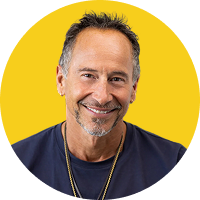


Host Jeffrey Saad sits down with his French teacher and Nichiren Buddhist practitioner, Alain, to discuss how past trauma shapes your internal narrative. Many high achievers let childhood stories and protective ego responses dictate their current decisions. Alain explains how understanding karma and practicing daily chanting help turn internal pain into actionable strength. You’ll learn practical ways to take complete ownership of your circle of control without staying trapped in old wounds. Tune in to discover how aligning your internal energy creates lasting joy and real peace of mind.
—
Listen to the podcast here
A Buddhist Take On How To Manage Your Story
Welcome, everybody. I’m extra excited because I have somebody on the show whom I respect and who has done a lot for my life. It is my prof de français, my French teacher, Alain.
Bonjour.
We’re going to do it all in French, but A) I’m not nearly ready for that, and B) You wouldn’t understand it.
You do pretty well for yourself.
Pretty good from Alain means good because he’s very strict. He’s a great French teacher. This is not a promotional thing, but if you need a French teacher, reach out to me because he is the best, especially if you’re in the LA area. How long have we known each other? Three years? Has it been that long?

Yes.
That’s crazy. I Googled “French teacher near Sherman Oaks” because I wanted to get my French, but I was also lazy and wanted it easy. He popped up, and I reached out to him. It has been a beautiful journey because A) I’m speaking French and understanding it, B) We’ve become great friends, and C) He’s fascinating. He’ll correct me as we go here, but he’s a full-on Buddhist. He’s not only a Buddhist, but what I love about Alain is he’s always trying to help other people. He loves using his version of Buddhism to do that, like chanting and different things, which I’ll let him tell you about.
Finding Freedom Outside Your Narrative
One of the topics we’re going to kick it off with is Alain and I were in French class. We were talking, and then I started talking about mindset and all the stuff that’s coming up in the reduction, which is coming out soon. You guys have heard about that. My stance is that we’ve all got a story that runs our life that comes from how we were raised, what happened, etc. We have different versions of how that story needs to exist in our lives. It’s your opinion, but it’s also Buddhism.
Talk about your version of what the story should be. You all know what I promote is to acknowledge it, look it in the face, and know that it’s running your life. It’s like, “I wasn’t loved enough. I am always afraid. I’m never good enough. Everything I’ve done is luck.” Once you know that’s your story, then my opinion is you let it go and only focus on, “What can I do starting today?” Many people are into therapy. If it works, you should do it. What’s your take on that? You had said to me, “You need to keep that story alive,” or something like that.
The way you pronounce it and expound it makes sense. Perhaps you can explain to me a little more from your personal example, like a story of how someone can either get hung up in it or move on and let go, so that I can understand and answer you better.
For me, I have a handful of friends that I love dearly. I’ve watched them do therapy their whole lives, or at least as long as I’ve known them, and I don’t see a change. I see many of them living in their story, keeping their story alive, which is the limbic brain, our defense system. We are this security system with consciousness. The security system takes over. There are no saber-toothed tigers, so we don’t need to react like that, but we react like that even if we get a text we don’t like. That system kicks in, and you start overthinking.
Getting triggered.
Reclaiming Control From Past Trauma
My mom most likely murdered my father when we were young. I was there right afterwards that morning. I lived my whole childhood, even after he died, with abuse, mostly verbal, some physical. I never once remember my mom telling me she loved me. Not once. I always felt disliked. I always felt like I had to prove something.
My story, and I admit it, is half the reason I love being a chef, a restaurateur, and being of service is because I want to be acknowledged. I want to give and go, “Didn’t I do good?” I’ve learned to say, even in my personal constitution. I am always grateful, but I won’t let my need for affirmation run my life. I’m going to recognize it and do what I do because I love it, not because I want the affirmation.
You talk about not getting stuck in the story.
Also, letting it run your decisions that you make. For me, that’s over. It’s history. It happened. It’s done. It’s not happening. As of now, I’m on top of the world. What’s happening in this moment? That’s all you ever have. I see other people who will be like, and you will hear them say it if you’re friends and spending time together fairly often, “With the way I grew up, I can’t do that or because of this, I can’t take that chance.” That’s their story running their life.
Thank you so much for clarifying because it makes so much sense. You and I agree. First of all, there’s no agree or not agree because we’re on a journey together to learn from each other, correct?
You don't have to let past trauma run your current choices. Recognize your story and step into active ownership today. Share on XCorrect.
Please, may I repay you the wonderful compliment that you gave me?
Take your time.
It’s a story. The story is that you gave me this wonderful compliment. Deep in my life, there’s a little voice that says, “You don’t deserve it.” Do you know what I’m saying?
Yes.
That’s the story, but where does the story come from? I wrote about it. I wrote a piece called The Lake of Pain on the Sea of Love.
I love that. You’re always so poetic.
The Lake of Pain is the pain and suffering that every single human being is born into this world with. I’ll try to bring in Buddhism here as part of the story. This is interesting. We may need a second episode for this. I have an experience of tremendous abuse with my dad. He broke my arm when I was three.
Tell that story quickly. That’s the tragic part. Tell the story of the way it went down, if you’re comfortable.
I’m writing a book. You’re my role model because I talk a lot, and you do. You’re a man of actions. I learn from you so much. Mom told me, “You were the happiest baby in the world. Nothing bothered you. You were silent in your crib for twenty minutes. I didn’t know what was going on. I went to see you, and you had tried to get out of the crib. You were hanging upside down because of your suspenders with a smile on your face.” When I was 3 or 4, I blocked out that memory. My earliest memory is going to preschool with a cast on my arm. There was a dark, looming figure behind me, which was my dad.
I didn’t know it should be that young. That is horrific.
I’m telling the story, but what I want to be very clear about is it’s one thing to tell the story, to look at the story, to look at yourself, and to know thyself. Plato said, “It’s very important to know thyself, not to be attached to the story.”
The story is not yourself, right, or is it?
We’re getting into Buddhism. It’s your karma. Karma is what you make of it. As a Nichiren Buddhist, I’m a member of SGI. I call it more of a humanism. It is humanism based on Buddhist principles. I don’t like the label I’m a Buddhist. In humanism, the human being is the most important thing. You are the universe. There’s no God out there deciding for you.
Turning Personal Suffering Into Strength
You own your calm. That’s what you and I are both saying. I don’t know if it’s a divergence in that. Maybe it’s not. If you let go and say, “I’m not going to pay attention,” for you, it’s different because, in my opinion, what happened to you is your karma. You brought that karma with you from a past life, but you use that to turn poison into medicine. That’s your victory in life.
I don’t understand karma as you do as a Buddhist.
I can explain.
Please do. We’re both saying the same thing, which is that it’s not about what you start with or what you get. It’s about how you move forward and deal with it. You get to choose what to do starting now or when something happens, even if it might be your karma or your parents.
Obstacles aren't here to stop you. They're here to build the exact strength you need to succeed. Share on XThat’s why I told this story about my dad. I had a great revelation a few years ago about my dad. There are zillions and trillions of worlds in the universe. We are so infinitesimal.
I am so with you. I love that.
My Buddhist mentor once said, “Our lives are as insignificant as a fly on the wall, but at the same time, they encompass the whole universe.” To me, what that means is that every single human being, it doesn’t matter who you are, what your karma is, and it doesn’t matter how evil you are. We have the power in our life, the beneficial positive power of the universe. This world is called the Sahā world. Sahā is a Buddhist term that means a world of suffering and endurance. This is me talking. This is not an official Buddhist line. It’s just me.
I always say, too, that everything is an interpretation. You and I have made most of the stuff up that we say. We’ve interpreted and brought it into our lives the way it works for us.
What I like is that we both speak from the heart. There’s no accident in life. The fact that you and I met is not an accident. There’s a Buddhist saying in Japanese that says when two strangers cross each other on the street, if the sleeves of the kimono barely graze each other, it’s because of a deep relationship from the past. We are in this amazing, beautiful symphony of life throughout the universe. I also wrote an article called Stranded on the Surface of Life. As you say in your book, people are so focused on the external. The inner life has a huge expanse that we don’t even dare to explore.
Going back to what I was saying, this world is a world of suffering. When you go to Europe, or you go to a foreign country, you need to show a visa. To be born in this world of endurance as human beings, because we’ve had many lives and we will have other lives, we need a visa. It’s called karmic suffering. We all choose to come into this world. What we do with this suffering, what we do with this obstacle, and what we do with this karma is going to decide whether we achieve our purpose in this life and why we came and were born in this world.
Everything is probability. In quantum physics, everything is probability. Now, you and I are talking, but there might be 1,000 different versions of Alain and Jeffrey talking. We’re not going to get into that. That’s esoteric. The question is, do you have a passive or a proactive view towards your karma? I’m not talking about the head. I’m talking about how, when you have a traumatic event happen in your life, it doesn’t happen in your head, and you can let it go. It gets embedded in every 1 of your 60 selves.
I 100 % agree.
Breaking Free From Reactive Patterns
With me, from that beautiful, happy baby, I became a very angry young man. I like to say I’m an angry old man. The thing is that I chose that karma.
When you say you chose that karma, you chose for your dad to break your arm because you wouldn’t listen to him?
No. You know what it was. He told me before the end of his life, because my whole life, I wanted to know what happened. It affected my life, my decisions, how I react to things, and the anger inside of my life that manifests even in the slightest movement, like the way I pick up something. You realize that it’s very deeply embedded. It still doesn’t mean it’s you. It’s an aspect of you.
It’s not you. It’s something that happened. There’s a big difference.
It’s something that happened that brings out certain conditions of life that exist in you, but at the same time, they exist in the universe. There are ten major conditions of life.
What would you rate yourself on dealing with that karma or that story? Are you at a seven? Are you at a ten? Are you at a two? That’s interesting to me. Even understanding it as deeply as you do and believing in karma and Buddhism, how have you managed it?
The Power Of Daily Chanting Practice
I can’t put a number on it, but I can tell you how I managed it through my chanting. I have to explain about chanting and going back to choosing your karma. The point I was trying to make is that by taking the story and using Buddhist practice, which you use on your own stuff, I used to chant Nam-myoho-renge-kyo, which I can explain.
I love that. I instantly felt a tingling in my body. That is so cool.
Thank you. When you had your issue with cancer, I was chanting for you every day.
I’ll never forget that picture. He sent me a picture of my picture on his altar, if you will. He was chanting for me. There were so many of you.

Also, I remember we were sitting outside of a street cafe. I was so blown away by your courage. You walk the talk. I remember sitting there. We were sitting at the cafe, and I put my hand on your chest. I was chanting, and the way you received it was so beautiful. I appreciate that. What we say in Buddhism is that there’s no poison that cannot become medicine.
I love that. I’m going to write that down.
The Chinese character for obstacle is opportunity. To make you happier, because I know you say similar things about obstacles, you need obstacles to become enlightened. Without obstacles, there’s no enlightenment. Without suffering, there’s no joy. When the Buddha appeared in this world, he suffered a lot too. His whole clan was wiped out when he was towards the end of His life. There’s a lot of stuff. We think of the Buddha as very serene. He didn’t stop walking and talking to people. That’s all he did. That all came after the monks. It came from the Greeks. The reason we take on suffering is so we can understand the suffering of other people.
Let’s go back to my story. I grew up with all this anger. My father was an American soldier in Casablanca. He met my mother, who was this beautiful Spanish-Jewish-French-Moroccan woman. He marries her. They go back to New York and have three kids. I’m ten months old when we go back to Morocco, and then we come back. I grew up in Morocco, and then this thing happened. We were five kids. It’s a beautiful life. I’m so happy I grew up there, but at the same time, he was angry with me. We come back to New York. I started school at sixteen at Columbia, and then there were all the riots. I dropped out.
That dropping out, the protesting, there’s the greatest picture of Alain in this full-length fur style coat with long hair, looking beautiful and a total rebel. I remember that picture. That story or karma drove you to make those decisions to rebel.
It’s the rebel in me. There’s a philosopher who said most men who experienced abuse from their dads or who have authoritarian fathers become rebels or criminals. I’ve had an amazing life. I still have a great life. It’s simpler than before.
We were talking about you rebelling. You said that most people who have had a bad father experience could have become criminals or rebels.
I can say without a doubt from my own certainty that my Buddhist practice has helped me. I’ll tell you why. I go to Colombia, travel, and come back. I went around the world, hitchhiked, and fell in love with a beautiful blonde girl at Columbia when I came back. I was twenty years old. After six months, we broke up. When we broke up, I went into a tailspin. I was depressed for two years. I was in a whirlpool. I couldn’t do anything. I almost got drafted. Two weeks before my induction, they abolished the draft. I’m a mess.
A friend of mine invited me to a Buddhist meeting. I expect to find the monk with the incense and all that stuff. That’s what I was drawn to. I go to a little apartment on the West Side. I’m wearing a Moroccan djellaba and necklaces. I’m barefoot. I have long hair. I walk into this tiny, little apartment packed with pretty awesome-looking kids. They were all chanting. They finally sent me to the meeting, and they’re all chanting this powerful thing. I couldn’t make out what it was. I’m thinking, “It sounds like, ‘We’re going downtown.’”
Was it the same chant you do now? It was the same. Do it again for a minute. I love it. It means, “I devote myself,” or, “I choose my life.”
Cause And Effect In Daily Choices
Nam-myoho-renge-kyo. It means, “I devote myself.” Nam is the mystical of the universe. Myoho is the energy of life and how it’s the shape that it takes. We’re a bunch of holes. Renge is simultaneous cause and effect, which means whenever we make a cause, we do any kind of action with our thoughts, our mouths, or our deeds. Immediately, there’s a reaction. It’s like, “What’s going to happen if I drop this glass?” What happens is it breaks, whether you like it or not. Sometimes, we make causes, and the effect is not manifested.
Give me an example.
When you kill somebody, and nobody catches you. You’re nice to your friend, like, “I love you,” and then when he or she walks away, you’re like, “What a jerk.”
You’re still affecting the karma, even if you don’t get an immediate result.
We’re creating causes every millisecond of our lives. We’re creating a cause. It’s a great cause because we seek it. Every single thought will indeed create causes. Immediately in the universe is a reaction. It’s not physics.
I agree. Energy is everything.
If it doesn’t manifest, what happens to the effect? It gets stored as energy in your life in the eighth consciousness. We have nine consciousnesses. That’s another time we could talk. We have the 9 consciousnesses and the 10 worlds. In the ninth consciousness, we have tremendous concepts of Buddhism. The most important thing is how to live as a human being and be happy in this world. Otherwise, it’s meaningless.
That’s what I always say. That’s my biggest pet peeve when people say, “I read that book. I know what you’re talking about.” Knowledge is worthless if you don’t put it to use. What I always say to people is, “How are you different since you read that? How are you different since you chanted with Alain? How are you different since you went to that workshop? If you haven’t changed, then you’re storing bad energy. You’re not moving forward. To know it is worthless.”
Channeling your rebellious energy into intentional action is the fastest way to build real authority in your life. Share on XThat’s why if I hadn’t had the amazing course I had at the beginning of my practice, I wouldn’t be here. Let’s go back to you having that latent energy in your eighth consciousness. That energy, the moment there’s a stimulus in the environment, it triggers the effect, and it becomes a manifest cause. When we die, our lives get sucked into the universe. You see your life as a form of energy. The negative energy or the negative karma will carry with us. We’re not only born with it, but in the intermittent state between life and death, we can also suffer from that negative karma. That’s what my Buddhism teaches, Nichiren Buddhism.
You have a little kid who’s born and suffers in either Gaza, Africa, or even here. What happened to you? What happened to me? We bring that karma with us. There are two schools of thought. One is, “I must be a bad person. I was a bad person in my previous life.” Let’s say something happens to you, trying to figure out your story. You said your friend took the therapist.
For us as Nichiren SGI Buddhists, there are three ways of looking at it. One way is if you’re a psychologist, you’ll say it has to do with your childhood. It has to do with your dad. You have to work on it. Go back fifteen years.” Having said that, I think therapy is extremely valuable, but it only goes so far. That’s one thing, your childhood.
A certain kind of Buddhism is what we call Hinayana Buddhism or certain provisional Buddhism. This is my personal take. I’m not saying I’m right. In a past life, we did this and that, and we’re getting the retribution. The Dalai Lama was once asked, “Why do you think what happened in Tibet happened?” He said, “We probably did something. It’s helping us to become compassionate.” Initially, Buddhism says, and it took me a while to be able to absorb this, “You own your karma, and you turn karma into a mission.”
With your actions.
There’s a great story that when the Buddha taught the Lotus Sutra, there were innumerable Bodhisattvas called Bodhisattvas of the Earth. The Buddha’s last teaching was called the Lotus Sutra. All His disciples were all around him. He said, “Who in history will propagate this wonderful law, the Mystic Law, that gone is the evil age? That’s to come.” They all say, “We will.”
He says, “You’re not tough enough.” The latter day below, which is the age we’re living now, is going to be so impure. The condition of life of the people is going to be so full of greed, anger, and stupidity. You can see it around us. The world is going to be like such a mess. You’re not strong enough, so who’s going to do it?” At that moment, millions and zillions of these amazing Bodhisattvas emerged. It’s all symbolic. He says, “They want to do it.” They’re incredibly enlightened people.
The first thing is that psychology says, “Fix your childhood.” The provisional Buddha says, “You did some bad karma in the past, so you better start doing some good karma right now. If you want to see the causes you made in the past, look at your life now. If you want to see what your life is like in the future, look at the causes you make right now.”
That is in line with me. Tell me if I got it wrong, but that’s saying you have a choice. Have a thought and take action. You get to move in the direction you want.
However, you can go in whatever direction you want. You said something in what I was hearing from your book. You can work hard. When you walk across the street to get hit by a car, that’s your karma. There’s nothing you can do about it. You call it The Circle, but I say let’s expand the circle. I’m with you on what you’re saying, but I’m saying that the reason I practice Nichiren Buddhism is to change the depths of a life and the eighth consciousness, the negative karma that we carry with us. Not only can we change ourselves, but we can change other people through changing ourselves.
That’s what I say. If you are constantly regurgitating your negative karma, your story, your childhood, or whatever, and think about trying to change the world and trying to change other people. Your circle keeps shrinking and getting crushed from the weight of that. If you only focus on what you can control and make good choices and good actions, your circle inflates. That’s where our philosophies cross over. The more your circle grows, the more positive affects you can have on the world. Think about it. If all of us are growing our circle, at some point, they overlap.
Don’t waste time on what you cannot do.
You’re holding back from making a difference in the world.
Let’s go forward with my story. I’m at that Buddhist meeting, and everybody’s chanting, “We’re going downtown.” I think, “This is a weird cult.” At the end of the meeting, they explain Nam-myoho-renge-kyo. They explain what it is. There’s a guy who’s leading the meeting. I didn’t like the meeting. I didn’t like the people. I didn’t like anybody.
I didn’t like the guy, but he said, “What are your dreams?” I said, “My dreams? Nobody asked me that before. I had dropped out of school. I want to make a film. I want to travel around the world. I want to touch people with what I do. This is who I want to be, but I don’t know how to get there.” He said, “Okay.” This guy was no nonsense, no philosophy. I was Jewish back then. I’m still Jewish. If you give me something for free, then I can’t refuse it. I get free samples even if I don’t want to eat them.
He says, “Go home. Chant Nam-myoho-renge-kyo for fifteen minutes in the morning and evening. Set up a small altar. That’s all. Do it for six weeks. If that doesn’t work for you, then stop. That’s all.” I said, “Okay. What do I have to lose?” I had never started anything before. I went home, set up an altar, and started chanting Nam-myoho-renge-kyo as he said for fifteen minutes.
Within two weeks, I felt like a heavy veil was lifted from me. I’m more focused. The girl I was crazy about was out of my system. I went back to Columbia. I went to graduate film school. I hadn’t even finished undergraduate. I said, “Can I take this?” I got to take three film classes without having to pay anything. A production, a screenwriting, and an acting class. I made a film. I got an A+ on the film. The teacher said to me, “That’s your vocation.”
After that, I started chanting, and I said, “Now I need a job.” This is New York City in the ‘70s. Nobody’s making movies. I’m chanting, and suddenly, in The Village Voice, which is like the LA Weekly, I see a classified ad for a production assistant wanted in a future film. That never happens. It was probably the only time in the history of the newspaper that this happened.
Stop looking for peace in external rewards. Real joy is self-produced when you master your inner narrative. Share on XMy roommate at the time said, “Don’t even bother. Hundreds of people will answer.” If I hadn’t been chanting, I would have listened to him. I felt more positive. I wrote a letter. I used two lines, which were, “I had no experience, and I finished school, but I will work my butt off for you guys.” They brought me in. Another 350 people were applying, but I got the job. I became associate producer and assistant editor on the film.
Out of 350 people, you get chosen.
I want to make it clear that it’s not magic. I was changing something.
That’s the point I wanted to get to. I find all this Buddhism fascinating, listening to you, the tone of your voice, and your energy in this room. I love it. When this show ends, what do I do with it? What is Buddhism for dummies? What did you achieve with that chanting? It wasn’t, “I’m going to chant and get everything I want.” The chanting changed something in you. What can people walk away with if they’re intrigued to do this?
Generating Unshakable Internal Joy
What they can walk away with is, first of all, everyone is a Buddha. We don’t judge anybody. It’s not like, “You got to do this. You got to do that.” There are more stories because I got everything I wanted and I chanted for. I had a beautiful home. I had a great career. I had an amazing life. I have two kids. I had a big obstacle, an injury, that turned my life upside down, but because I continued to practice, this is when my life started expanding. This is where my real spiritual journey begins. It is still going on. It’s the reconnection to the fundamental energy of the universe. It’s the reconnection to our true self. All the millions in the world, all the things you can accomplish have their comparison.
What is the homework? What if I want to start Buddhism, but I don’t want to be overwhelmed?
I will tell you exactly what the guy told me at the meeting. You go home, sit in front of a wall, and chant Nam-myoho-renge-kyo for 5 minutes, 10 minutes, or 15 minutes. You keep your eyes open. Write down everything that you want to see happen in your life. You want to make $1 million? You write that down. You want your wife to leave you? You write that down.
Is it the chanting that’s making it come true? What’s happening?
It’s the chanting, and we recite an excerpt of the Lotus Sutra. We have an organization. We do practice. We help other people. We propagate the law. We have meetings. You study Buddhism. You chant every single day. Ultimately, the beginning is the whole world. Start doing it morning and evening, twice a day, every day, for a few weeks.
Would I be wrong to say, and this may be me trying to force it into my thinking, so that’s why I want you to correct me if I’m wrong, that the chanting, what it’s doing is making you present? When you are present, you tap into the subconscious, which is where the real depth is and the connection to the universe. That’s how you bring these things into your life. What I don’t want people tuning in to think is that we’re saying, “If I chant Nam-myoho-renge-kyo, everything’s going to happen for me,” or is it?
Let’s go back to the fly on the wall. Let’s not try to grasp the immensity of life with our brains. The reason it worked for me is that I didn’t have any expectations, and I didn’t try to wrap my brain around it. Faith is very important, but not faith in the outside God. It is faith in the power of your own life. It is faith in the fact that you are the Buddha and the other person is the Buddha.
What happens, because I can describe it for you, is that when we chant Nam-myoho-renge-kyo, it’s a fundamental rhythm. We reconnect like tuning forks. If you have two instruments that play out of tune, it’s horrible music. When it’s in tune, it’s beautiful music. When you have a tuning fork, and you hit it, it vibrates. The other tuning fork is next to it, and it starts vibrating. From my point of view, we are plugging into chanting to the beautiful music of the universe.
You’re tapping into the universal energy.
It’s pure joy. You talk about joy no matter what. This is where you and I come to the finishing line the same. This is what it’s all about. It is being happy. It is not because, no matter what’s going on in the world, I’m going to feel happy because I’m going to let it go and focus on my happiness, but because at the source of life, there’s a spring in the depths of every person. That is pure joy. Not just here, but throughout the whole universe.
The idea is joy doesn’t come from something you get or someone you get from something external. Joy emanates from inside of you into the world. That’s the key because then joy is never contingent. It’s self-produced, whether it’s chanting, being present, or focusing on this work. We’re going to have to have another episode because this is so much to take in.
I’d love to share some of the concepts. Having said that, it’s everyone’s experience. You can do it, and it won’t work for you.

That’s what I was saying. I preach, I learn, and I love. I’ve made it a part of my life, and it has made my life great. I always tell people, “If you wake up and you can say, ‘I love my life,’ turn me off. You don’t need it, or maybe you want some reinforcements.” That’s what it comes down to. This is not about me being you, you being me, or us following some guide. This is about very simply being your best self, whatever that looks like. Let’s wrap it up with a chant. I’ve never done it in my life. I want to do it. Tell me what I need to do.
We have a bell. Sit comfortably. Keep your eyes open because we’re not trying to go inside. We’ll bring the Buddha out. Your mind is going to have all these things, but it’s okay. Put out there exactly what you want to see happening. We ring the bell, and then we start chanting. Follow me. Can you say it? Nam.
Nam.
Myoho.
Myoho.
Renge.
Renge.
Kyo.
Kyo.
Try to follow me. Nam-myoho-renge-kyo. Can you say it? I want to hear you say it.
Nam-myoho-renge-kyo. That is amazing.
Do it for a week, and then come back and tell me.
In my next episode. I won’t be on a roll, but I will be fully geeked out. Thank you.
Was it okay?
It was beautiful. Are we going to have a French class?
Let’s do it.
Cheers.
Important Links
- French Tutoring & Conversation avec Alain in LA and Online Around the World
- Jeffrey Saad on Instagram
- The Circle on Apple Podcasts
About Alain
 Born in NYC to a French Spanish Moroccan Jewish mother and a Russian German Jewish father, Alain grew up in Casablanca, and returned to NYC to study at Columbia University.
An extensive career as an international film executive with such companies as New Line Cinema and 21st Century film was cut short due to an injury, turning his world upside down.
“What seemed the end of a career was actually the beginning of a great spiritual journey that compelled me to open up the vast inner landscape of the heart “.
Alain is a practicing buddhist and spends his time writing, teaching french, and learning about life from his two beautiful daughters and his absolutely awesome granddaughter. He lives in Los Angeles.